
Your 3-part playbook for keeping your lawn alive, and looking good, when July gets hot
It’s spring, and right now your lawn probably looks incredible. Northeast Ohio just handed us one of the wettest springs in recent memory, and if you live anywhere from Mentor to Chagrin Falls, you’ve probably walked past your yard lately and thought, wow. Enjoy that feeling. You’ve earned it.
The lawn you have in April is a different lawn than the one you’ll have in August. Summer in Lake, Geauga, and Cuyahoga counties has a way of humbling even the greenest grass. If you go in with a plan, you’ll come out the other side with a yard your neighbors envy. If you don’t, you’ll spend July and August watching your grass go brown and wondering what went wrong.
This guide is your head start. Three simple shifts, two that are up to you and one that’s up to us, will carry your lawn through whatever summer lawn stress this year throws at it. (If you’re catching up from earlier in the season, our guide to late spring lawn care in Ohio is a good companion to this one.)
One note before we dive in. The homeowners who get the most out of lawn care are the ones who show up with curiosity instead of judgment. A lot of folks treat their lawn guy like a fertilizer delivery service. We’d love for you to think of us more like a coach. Lawns are living systems, and the best outcomes happen when you and your lawn care team work together.
☀️ First, know your enemy: heat and drought are two different problems
Most homeowners lump summer stress into one bucket, something like “it’s hot and dry.” But heat and drought are separate problems, and your grass experiences them differently.
- Heat stress happens when air and soil temperatures sit above 85° for days at a stretch. Cool-season grasses, which make up most of what grows in Northeast Ohio, slow down, stop producing new growth, and shift into survival mode.
- Drought stress happens when the soil dries out. Even a moderately warm week without rain can trigger it, especially on lawns with thin or compacted soil.
Sometimes you get both at once. Last summer we had three straight months of 90-degree weather with almost no rainfall, and we’re still seeing lawns with stressed spots from it six and eight months later. That’s how long the damage can linger, and it’s exactly why going into summer with a plan matters so much.
The grass you have is important (and it’s probably a blend)
Before we talk about what to do, a quick word about what’s growing under your feet.
Most Northeast Ohio lawns aren’t one kind of grass. They’re a blend, and that’s a good thing. Here’s a quick cheat sheet:
| Grass type | What it loves | Ideal mow height |
|---|---|---|
| Kentucky bluegrass | Cool springs, full sun | ~4 inches |
| Turf-type tall fescue | Sunny areas, heat tolerance | ~4 inches |
| Fine fescue | Shade, cool weather | ~3.5 to 4 inches |
| Perennial ryegrass | Quick germination, mixed conditions | ~3.5 to 4 inches |
Here’s an easy way to think about it. Asking for “Kentucky bluegrass” is like walking into a salon and asking for red hair. There are hundreds of red! A great red is almost always a blend, a little brunette, a touch of blonde, a warm red note woven in. Grass seed works the same way. The best lawns use blends put together by professional seed houses in Oregon, where they actually know what conditions each variety thrives in. That’s different from the bag on sale at the big-box store, where the guy stocking shelves is also expected to be an expert in lawn chairs, petunias, and turf-type tall fescue.
The takeaway: if your full-sun front yard was planted with a shade blend, no amount of watering, mowing, or fertilizer is going to make it perform. That’s just nature. A quick assessment can tell you whether you’re fighting an uphill battle.
Your role, Part 1: Don’t scalp your lawn
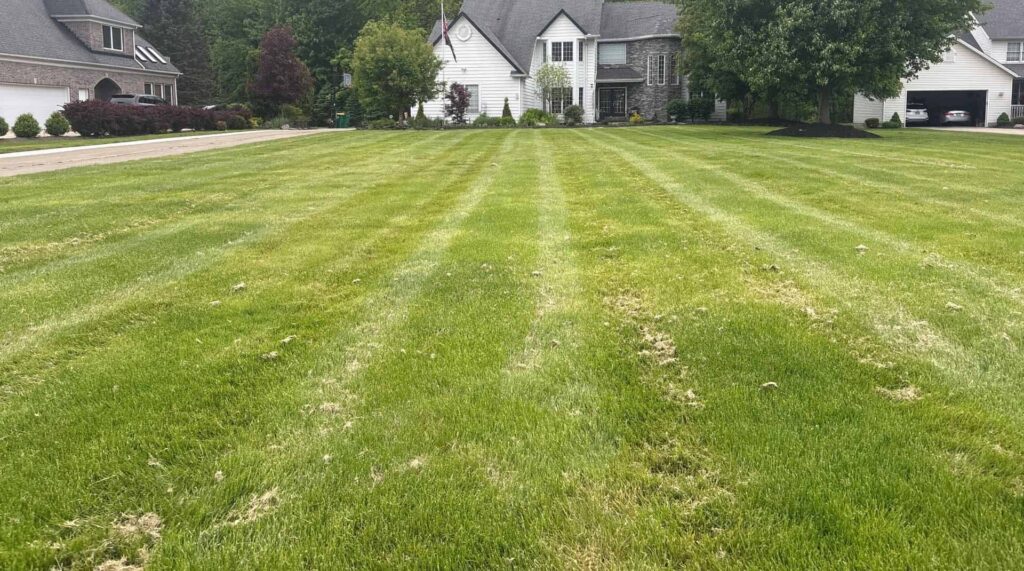
This is the single biggest DIY mistake we see every summer, and it’s driven by a completely reasonable impulse. If I cut it shorter, I won’t have to mow as often.
We get it. Mowing is a chore. But here’s what happens when you drop the deck down to 2 or 2.5 inches.
- The soil around the roots dries out much quicker
- Photosynthesis drops because there’s less leaf surface
- Weed seeds, crabgrass especially, get the sunlight they need to germinate
- The lawn loses its ability to shade itself during a heat wave
Scalping is the term for mowing so short that you expose the crown of the plant, the growing point where the leaf blade meets the root. When that crown takes direct sun, a few things go wrong fast:
The fix is simple. Raise your mower to around 4 inches for most Northeast Ohio lawns, and especially for Kentucky bluegrass. You’ll mow a little more often in May, a lot less often in July and August, and your lawn will stay green through dry stretches that would turn a scalped lawn brown. (For the full rundown on blade sharpening, mowing frequency, and technique, see our best lawn mowing tips for Mentor-area lawns.)
One more thing. Watch your edges. When you trim along a driveway, sidewalk, or flower bed and scalp the outer 4 inches down to bare dirt, that’s exactly where crabgrass shows up in August. Trim cleanly. Don’t shave it. (If crabgrass has been a recurring problem on your lawn, here’s how to stop it before it starts.)
💧 Your role, Part 2: Water like you mean it, or don’t water at all
Watering is where good intentions tend to go sideways.
If you’re going to water, water deeply and infrequently, in the morning. About 1 inch of water per week, delivered in one or two long sessions, beats a little sprinkle every evening. Morning watering gives the blades time to dry before nightfall. Evening watering leaves your lawn wet overnight, which is an open invitation to fungal disease.
If you can’t water, don’t force it. A lot of homeowners tell us, “I don’t have irrigation” or “My yard’s too big to water.” That’s completely fine. Here’s the secret: a taller mowing height can carry your lawn through a dry summer even without an irrigation system.
Here’s why. A longer leaf blade shades the crown of the plant. A shaded crown means cooler soil. Cooler soil holds moisture longer. Soil that holds moisture longer means your lawn can ride out a two-week dry stretch without collapsing. That’s the whole trick.
So if you’re not watering, mow higher. Your lawn will do the rest.
Dormant vs. dead: don’t panic in July
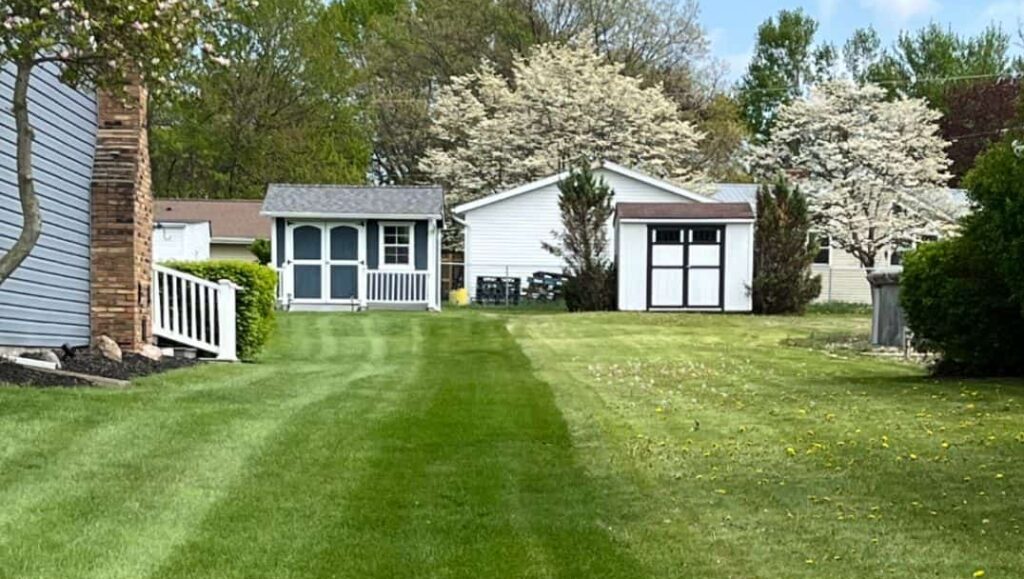
Around mid-July, you may look outside and see brown patches. The first question everyone asks is, Is it dead?
Usually, no. Cool-season grasses go dormant as a survival strategy. They pull energy down into the roots, let the top growth brown out, and wait for cooler, wetter weather to bounce back. A dormant lawn looks dead. It isn’t.
The real trap is timing. Many homeowners shrug off dormancy in July (“it’ll be fine, it’ll come back in the fall”), and then October rolls around, the neighbors’ yards are lush and green, and theirs is still patchy. That’s the moment people realize some areas actually did die. Now they’re looking at aeration and overseeding and a much bigger recovery project than they bargained for.
The best way to tell dormant from dead before October? Work with someone who’s watching your lawn all season and can spot genuinely declining areas early, while there’s still time to adjust.
That’s where we come in.
🌱 Ecolawn’s role: building healthy soil
Here’s a belief we run into constantly. People assume you put fertilizer on the lawn, the grass eats it, and the grass turns green.
We wish it were that simple. If it were, the four-step bag from the hardware store would be the only thing anyone ever needed, and every lawn in Northeast Ohio would look like a golf course.
The reality is that healthy grass is a byproduct of healthy soil. Our work happens underneath your lawn, in the soil itself. When the nutrients are in the soil, your lawn decides on its own terms when and how to use them. That’s why our approach is built around what’s happening underground: microbial activity, soil structure, organic matter, nutrient availability.
When the soil is right, a few things happen on their own:
- The grass gets thick enough that there’s no room for weeds to establish
- The root system deepens, making the lawn far more drought-resilient
- The color deepens into a lasting green that holds through the season
- You need fewer herbicide applications over time.
This is also why our schedule doesn’t run on holiday dates. Every so often, someone will ask us to come on Memorial Day, the Fourth of July, Labor Day, and one more date, because that’s what they always did, and the lawn looked fine. We understand the instinct. Our job is to apply the right product at the right time based on what your soil and your grass are actually doing. The calendar of summer barbecues doesn’t drive the schedule.
The end result is a lawn so thick and soft you’ll want to wiggle your toes in i! That’s what healthy soil produces when you give it time to work. (If you’re wondering why two lawn care programs can look identical on a quote but produce wildly different results, here’s why lawn care isn’t really a commodity.)
What to expect if we’re caring for your lawn this summer
Whether you’ve been with us for years or you’re thinking about hiring us for the first time, it’s worth setting honest expectations.
- Short-term: If you come on board mid-summer during a drought, a stressed lawn won’t green up overnight. Our first job is to stabilize it, protect it, and set it up for a strong fall and spring recovery.
- Medium-term: Over one full season, the difference starts showing. Fewer weed issues, better color retention, less stress during dry stretches.
- Long-term: After two or three seasons of consistent soil-focused care, drought stops being scary. Your lawn rides out what used to wreck it.
Before you panic, call us
If you’re seeing brown patches, worrying about weeds, or just not sure what to do next, don’t Google your way to a $200 mistake at the garden center. DIY looks cheaper on paper until it isn’t, and we’ve done the math on that one in our breakdown of the true cost of DIY vs. professional lawn care in Ohio. Let’s walk your lawn together instead.
We offer free lawn evaluations throughout Lake, Geauga, and Cuyahoga counties. We’ll tell you what’s actually going on, what’s normal for this time of year, and what (if anything) you need to do about it.
Summer doesn’t have to be the season you lose your lawn. With the right plan and a little patience, it can be the season your neighbors start asking what you’re doing differently.

Frequently Asked Questions About Summer Lawn Care in Ohio
Is my lawn dead or just dormant?
Most Northeast Ohio lawns that turn brown in July or August are dormant rather than dead. Dormant grass pulls energy into its roots and will green up again when cooler, wetter weather returns. If patches are still brown by October when surrounding lawns are green again, those areas are likely dead and will need aeration and overseeding to recover.
How tall should I cut my grass in Northeast Ohio during summer?
Around 4 inches is the sweet spot for most Northeast Ohio lawns, especially Kentucky bluegrass. Taller grass shades the crown of the plant, keeps soil cooler, and dramatically reduces water loss during heat and drought. Cutting at 2 to 2.5 inches, which many homeowners do to reduce mowing frequency, causes scalping, invites crabgrass, and leaves the lawn more vulnerable to summer stress.
How often should I water my lawn during a drought in Ohio?
If you choose to water, aim for about 1 inch of water per week delivered in one or two deep sessions in the morning. Deep, infrequent watering trains roots to grow down into the soil, which makes your lawn more drought-resilient. Light daily sprinkling keeps roots shallow and stressed.
Can I have a healthy lawn without an irrigation system?
Yes. Homeowners without irrigation can keep their lawns healthy through dry Ohio summers by raising their mowing height to around 4 inches. A longer leaf blade shades the soil, conserves moisture, and significantly reduces the need for supplemental watering.
What’s the best time of day to water my lawn?
Early morning, ideally between 4 AM and 9 AM. Morning watering allows the grass blades to dry before evening, which prevents fungal disease. Watering at night leaves the lawn wet overnight and creates ideal conditions for fungus and turf disease.
Should I fertilize my lawn during a drought?
No. Applying fertilizer to a drought-stressed lawn can burn the grass and push growth the plant doesn’t have the resources to support. A soil-focused lawn care approach adjusts product timing based on current conditions rather than sticking to a rigid holiday calendar.
What’s the difference between heat stress and drought stress on a lawn?
Heat stress happens when temperatures stay above 85° for days and cool-season grasses slow down or stop growing. Drought stress happens when the soil dries out from lack of rainfall. They often occur together in a Northeast Ohio summer, which compounds the damage and extends recovery time.
Why does my lawn still have weeds even though I pay for lawn care?
Weeds show up when there’s bare soil or thin turf for them to colonize. A soil-focused lawn care approach builds turf density over time, which crowds out most weeds naturally. Dandelions can still appear briefly during ideal germination conditions (around 70°, sunny, with recent rain), but they’re easily treated and don’t reflect long-term lawn health.
When should I aerate and overseed my Ohio lawn after a dry summer?
Early fall, typically late August through September, is the ideal window in Northeast Ohio. Cool nights, warm soil, and reliable rainfall give new seed the best chance to establish before winter. Aerating and overseeding after a stressful summer is often the fastest way to recover thin or damaged areas.